鈥淯ltracold molecules are probably one of the most exciting things that people are trying to get in my field right now,鈥� Dr. Wright said.
by Bonnie Eissner
 It has been 17 years since the Nobel Prize in Physics was awarded to three scientists鈥擲teven Chu, Ph.D. (who later served as the U.S. secretary of energy), Claude Cohen-Tannoudji, Ph.D., and William D. Phillips, Ph.D.鈥攆or figuring out how to slow down and trap atoms in order to study them.
At room temperature, atoms move too fast to be studied (about 4,000 km/hr). To slow them down, you can lower the temperature, but that typically means that the busy gas atoms condense into liquids and solids, at which point they鈥檙e too close together to analyze easily. Working independently, the three Nobel Prize鈥搘inners developed techniques to use lasers to cool and slow down atoms in dense clouds, without allowing them to liquefy or solidify.
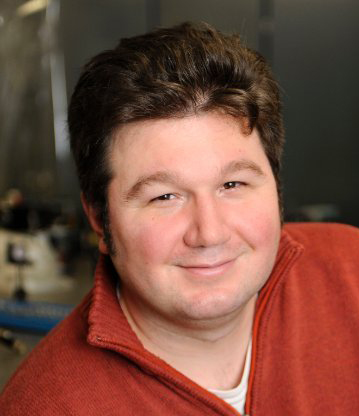
Fast forward to the present, and this method has become widespread in quantum physics.听Matthew Wright, Ph.D.., an assistant professor of听, likens building a magneto-optical trap, or MOT, which is the standard device used for cooling and trapping atoms, to building a radio. It鈥檚 old stuff. The new, hot area in quantum physics, according to Dr. Wright, is cooling and trapping molecules. And that鈥檚 where he and a band of seven undergraduates who work in his lab are expending their energy.
What鈥檚 the big deal about cooling molecules? For one, they鈥檙e more complex, so slowing them down is more complex. Their intricacy also makes them more interesting to study. In Dr.听Wright鈥檚 words, 鈥淎toms are pretty dumb鈥� compared to molecules; 鈥渢hey just sit there. Molecules can be much more exciting: they can vibrate, rotate, bend and interact in strange ways.鈥�
One way to create cold, trapped molecules is to assemble them with cold, trapped atoms. Dr. Wright and his team of undergraduates are working on doing just that. Their technique is to use frequency chirped laser pulses to control the atom collisions. The pulsing refers to laser light going on and off at nanosecond speeds, like an insanely fast strobe light. The chirping means that within each pulse, the frequency of the light is changing鈥攕imilar to the way a bird chirp varies in pitch.
Dr. Wright explained that this method isn鈥檛 necessarily new鈥� there are a handful of people who are already doing it. His twist is to adjust the laser pulses and chirps to match the speed and movement of colliding atoms. In so doing, he and his team can create more collisions and ultimately more molecules to study.
鈥淯ltracold molecules are probably one of the most exciting things that people are trying to get in my field right now,鈥� Dr. Wright said. His ultimate goal is to be able to not just make, but also study these molecules.
And, as much as he enjoys working at the forefront of his field, he relishes collaborating with undergraduate students. 鈥淲hen a student comes up to me and says that they want to work in my lab, I have a hard time saying no,鈥� said Dr. Wright when asked how he came to have seven undergraduate research assistants.
鈥淚 see my research as an opportunity for students to learn,鈥� he said, explaining that they learn not just physics, but also how to work with a boss and, hopefully, discover their professional passion鈥攚hether it鈥檚 physics or another field. 鈥淭here are many different ways to be successful in life,鈥� Dr. Wright said.
Martin Disla 鈥�14, the first student to work in Dr. Wright鈥檚 lab, is now pursuing a Ph.D. in Physics at the University of Connecticut. Of Dr. Wright, he said: 鈥淗e is brilliant to work with and is always willing to help and offer advice, whether it is a problem in the lab or an outside concern. By sharing in the good times of our research as well as the frustrations, we were able to form a great friendship and that is a wonderful thing to have鈥攚hen your boss is not only a mentor to you but a friend you know you can count on.鈥�
For further information, please contact:
Todd Wilson
Strategic Communications Director听
p 鈥� 516.237.8634
e 鈥� twilson@adelphi.edu