The former McDonell Summer Science Research Fellow is pursuing a Ph.D. in Entomology at Penn State University.
Is it possible that studying a small strain of parasitic wasp could unlock the door to new biotechnology and improved solar panels? Carolyn Trietsch 鈥�12, M.S. 鈥�14, thinks so.
Trietsch is currently pursuing a Ph.D. in Entomology at Penn State University and working at Penn State鈥檚 Frost Entomological Museum. There, she is studying the super family of wasps known as ceraphronoid and making surprising discoveries.
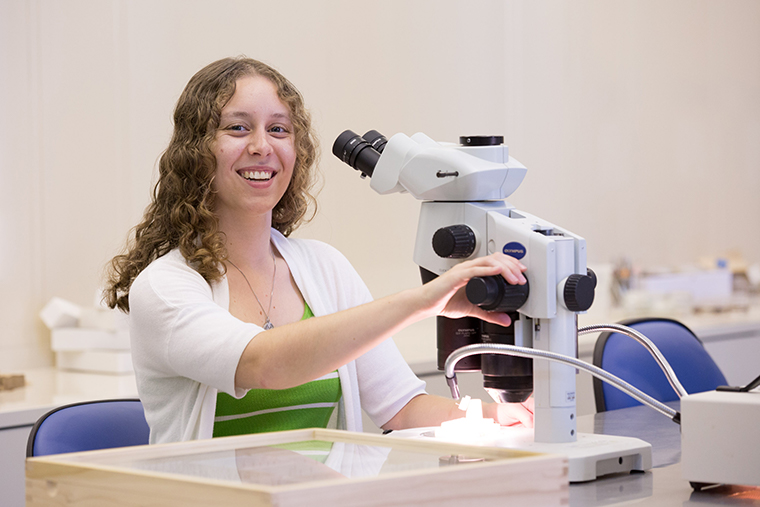
Carolyn Trietsch 鈥�12, M.S. 鈥�14, a former Adelphi McDonell Summer Science Research Fellow, is now pursuing a Ph.D. in Entomology at Penn State University.
鈥淎 lot of people don鈥檛 know how to identify them,鈥� Trietsch explained, 鈥渟o we鈥檙e working on morphological and also genetic characteristics to identify these wasps.鈥�
In studying the ceraphronoid wasps, Trietsch and other researchers found semitransparent patches on the abdomen, though the purpose of these patches is still unclear. 鈥淚n other groups of wasps, [scientists] found that the patch is able to focus light on structures underneath the cuticle; the wasps are able to store solar energy, like a battery, and use听it to fuel the metabolism,鈥� she said.
She has recently submitted a request for a grant from the Sigma Xi Scientific Research Society to look more closely at the semitransparent panels found along some of the ceraphronoid wasps.
鈥淲hat I thought would be interesting is if these semitransparent patches and cuticles could actually focus light on structures鈥攖hen you can use that in solar technology to focus light in solar panels to make them more efficient.鈥�
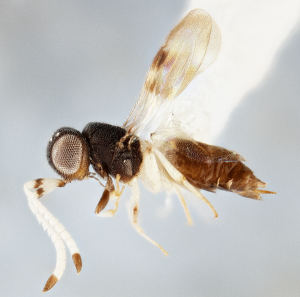
Trietsch believes that this small strain of parasitic wasp could lead to improved solar panels and new biotechnology.
Trietsch鈥檚 first experience with entomology research came from her participation in Adelphi’s Horace G. McDonell Summer Science Research Fellowship as an undergraduate. The grant allowed her to spend a summer on Long Island鈥檚 salt marshes collecting samples of insects to classify under the guidance of Associate Professor Matthias听Foellmer, Ph.D.
鈥淲orking in the salt marshes identifying insects is how I taught myself entomology taxonomy, and how I got into taxonomy,鈥� she said. 鈥淚t also prepared me for fieldwork in my research now.鈥�
The McDonell Fellowship began in 2011 through the generosity of Horace G. McDonell Jr. 鈥�52,鈥�02 (Hon.). Support from the alumnus and former Adelphi trustee allows students a $4,000 stipend to commit to a summer of fieldwork and research with the guidance of an Adelphi faculty member. The 10-week fellowship gives students a hands-on experience with scientific research: 39 students have participated since it began.
Trietsch鈥檚 younger brother, Michael Trietsch 鈥�15, also participated in the fellowship. He conducted physics research at Adelphi and is now pursuing a second bachelor鈥檚 degree in engineering at Columbia University. 鈥淗e actually just got an internship at Con Edison,鈥� Carolyn added.
Others, like Ililochi Onwuzu 鈥�12, have launched careers in high tech. Onwuzu received a master鈥檚 degree in applied physics from the University of Oregon and is currently a failure analysis engineer at Intel Corporation.
Trietsch鈥檚 evolution from classifying local insects over the summer to filling in taxonomic gaps has given her the chance to pursue the research that interests her the most.
鈥淢y experience in the marshes…really sparked my passion for entomology,鈥� she said.
For further information, please contact:
Todd Wilson
Strategic Communications Director听
p 鈥� 516.237.8634
e 鈥� twilson@adelphi.edu